

CLINICAL ARTICLE
Why Facial Lifting Looks Different on Every Face?
Facial lifting results vary by individual due to factors like skin type, age, bone structure, and technique used. Discover what affects your unique outcome!
Why Facial Lifting Looks Different on Every Face?

If you sit in our consultation room long enough, you’ll hear a familiar sentence.
“I’ve seen facelift results online—but why do they all look so different?”
To be honest, this is one of the most perceptive questions a patient can ask. And it reveals something important: facial lifting is not a standardized procedure, even when the surgical name is the same. Two patients may both undergo a “facelift,” yet their outcomes—shape, tension, softness, and even the way they age afterward—can look entirely different.
At Sinsang Plastic and Reconstructive Surgery in Gangnam, we explain this clearly from the start. A facelift is not a template. It is a response to a face—your face—with its own anatomy, aging pattern, and structural history.
Let’s talk honestly about why facial lifting looks different on every individual, and what truly determines a natural, long-lasting result.
The Face Does Not Age as One Unit
One of the biggest misconceptions about facial aging is that everything “sags downward” in the same way.
In reality, aging happens in layers, and those layers change at different speeds.
Skin loses elasticity.
Fat compartments shift, shrink, or descend.
Ligaments loosen.
Muscle tone weakens.
Bone structure subtly resorbs over time.
Imagine a traditional Korean hanok. The roof may droop, but the beams beneath it also settle, and the foundation itself may change shape. Simply tightening the roof fabric doesn’t restore harmony—you must understand the structure underneath.
This is why lifting looks different from face to face: each person’s structural aging map is unique.
Bone Structure: The Quiet Architect of Your Result
Before we ever discuss incision lines or lifting vectors, we evaluate bone structure.
High cheekbones, a wide zygomatic arch, a retruded chin, or a strong mandibular angle—all of these affect how lifting tension distributes across the face.
A patient with strong skeletal support often requires less aggressive lifting to achieve a refreshed look. Another patient, with volume loss in the midface or jawline, may need structural support through fat repositioning or regenerative augmentation to avoid a hollow or “over-pulled” appearance.
This is one reason copying another person’s result rarely works.
You are not lifting skin onto a blank canvas—you are lifting it over a living framework.
The SMAS Layer: Where Most Differences Are Decided
If there is one structure that separates refined facelifts from disappointing ones, it is the SMAS layer (Superficial Musculoaponeurotic System).
This fibromuscular layer acts like the internal suspension system of the face. It connects facial muscles to the skin and determines how expressions move—and how they age.
What many patients don’t realize is this:
the SMAS is not identical in thickness, elasticity, or strength in every person.
Some patients have a dense, resilient SMAS that holds sutures beautifully. Others have a thinner or more fragmented layer, especially after weight fluctuations or previous procedures.
At Sinsang, we adjust our SMAS strategy accordingly:
- In some faces, we reposition and reinforce
- In others, we reshape and selectively release
- In certain cases, excessive tension is avoided altogether to preserve softness
A “one-technique-for-all” approach simply doesn’t work here.
Fat Is Not Just Volume—It’s Directional
Facial fat is divided into distinct compartments, each aging differently.
Some descend.
Some shrink.
Some paradoxically enlarge with age.
This is why two patients with similar wrinkles may look entirely different in profile or three-quarter view.
If a surgeon lifts without evaluating deep and superficial fat compartments, the result may look tight—but not youthful.
At our clinic, ultrasonic diagnostic imaging helps us assess fat depth and mobility before surgery. This allows us to decide whether fat should be repositioned, preserved, or supplemented with regenerative methods.
When lifting respects fat architecture, the face looks rested—not sculpted.
Skin Quality Changes the “Finish” of the Lift

Think of skin like fabric.
Some fabric drapes beautifully after tailoring.
Some wrinkles easily.
Some resists tension altogether.
Skin thickness, elasticity, sun damage, smoking history, and genetic collagen quality all influence how lifting tension appears on the surface.
This is why:
- Thinner skin may show sharper definition but requires gentler handling
- Thicker skin may need deeper structural support to avoid heaviness
- Poor skin quality benefits significantly from regenerative therapy during recovery
A facelift does not end in the operating room. Healing quality shapes the final appearance just as much as surgical precision.
Cultural Aesthetic Preferences Matter More Than People Admit
In Korea—especially in Gangnam—patients consistently express one fear:
“I don’t want to look like I’ve had surgery.”
Western lifting trends historically emphasized dramatic tightening. Korean patients, however, often seek natural aging correction, not transformation.
This cultural expectation influences everything:
- Vector direction
- Degree of tension
- Incision placement
- Use of regenerative adjuncts rather than aggressive excision
At Sinsang, we design lifts that align with how faces are perceived in daily life—under natural light, in motion, during conversation.
A result that looks impressive in still photos but feels unnatural in expression is not a success.
Neck and Face Must Be Treated as One System
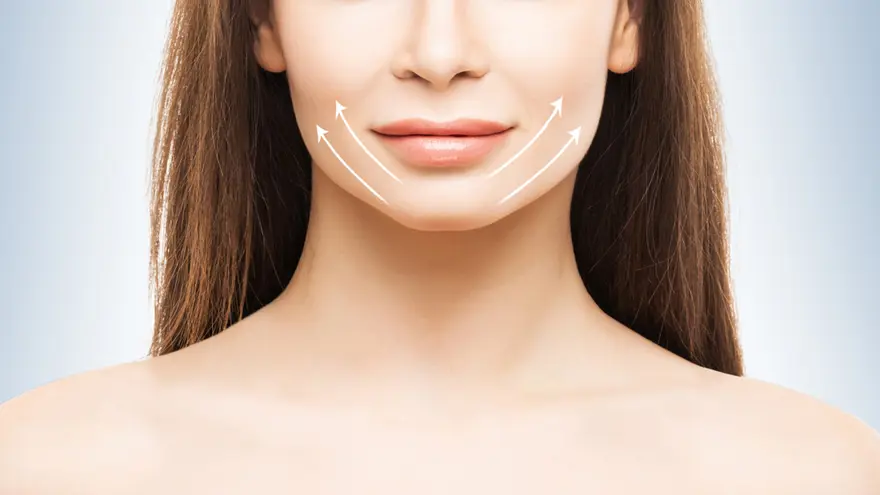
One of the most common reasons lifting “looks different” is incomplete planning—especially regarding the neck.
A lifted face with an untreated neck looks disconnected.
A tightened neck without facial balance looks artificial.
The neck ages through:
- Platysma muscle banding
- Deep fat accumulation under the chin
- Loss of mandibular definition
If these are not evaluated together, results vary dramatically between patients—even with similar facial procedures.
This is why we approach facial and neck contouring as a single anatomical system, not separate surgeries.
Healing Response Is Individual—and Predictable
Some patients swell minimally.
Some scar invisibly.
Others need more time for tissues to settle.
This isn’t luck—it’s biology.
Factors such as vascularity, inflammatory response, and lymphatic drainage influence how quickly lifting results soften into their final form.
Our in-house stem cell and regenerative therapies are not used to “enhance beauty,” but to support healing quality—reducing fibrosis, improving skin recovery, and helping tissues integrate naturally after repositioning.
Long-term outcomes depend on this phase more than many realize.
Surgeon Philosophy Shapes the Outcome
Perhaps the most overlooked factor is this:
Every facelift reflects the surgeon’s philosophy.
Some surgeons prioritize tightness.
Others prioritize longevity.
Some focus on profile; others on frontal harmony.
At Sinsang Plastic and Reconstructive Surgery, led by Dr. Young Jae Lee, our approach is guided by responsibility and restraint. With a background in academic plastic surgery and regenerative science, Dr. Lee emphasizes:
- Structural correction over surface tension
- Diagnostic precision over standardized technique
- Long-term facial harmony over immediate drama
This philosophy naturally produces results that look different—because they are designed differently.
So, Why Does Facial Lifting Look Different on Every Face?
Because no two faces share the same:
- Bone structure
- SMAS integrity
- Fat compartment behavior
- Skin quality
- Aging pattern
- Healing response
- Aesthetic goal
A facelift is not a product—it is a process of interpretation.
When performed thoughtfully, it doesn’t erase age. It restores balance.
A Thoughtful Next Step
If you are considering facial lifting—whether you are a local patient comparing Gangnam clinics or a visitor exploring aesthetic surgery in Korea—look beyond before-and-after photos.
Ask about diagnostics.
Ask how your anatomy will be evaluated.
Ask who is responsible for planning and execution.
A consultation with a board-certified surgeon who treats facial lifting as a tailored medical decision—not a cosmetic template—can change everything.
At Sinsang Plastic and Reconstructive Surgery, we believe your face deserves that level of respect.
Clinical Guidance & Recovery Considerations
All surgical and non-surgical treatments carry potential risks such as temporary swelling, bruising, asymmetry, or infection depending on individual anatomy. Detailed indications and personalized recovery expectations are confirmed during in-person ultrasonic evaluation with a Sinsang board-certified specialist.
Patient Concierge
Gangnam Station / Sinsa Area · 150 Dosan-daero 5F–6F, Seoul
Mon–Thu 10:00–19:00 · Fri 10:00–21:00 · Sat 10:00–17:00
Online Inquiry Form →WhatsApp (+1 201-940-3238)LINE (@853akazy)CONTINUE EXPLORING
More Medical Insights

Rising Demand for Double Chin Revision Surgery: Korean Market Price Trends
Rising Demand for Double Chin Revision Surgery: Korean Market Price Trends
Explore →

What is fat grafting - Procedure, Uses, Types, Benefits, and Risks
What is fat grafting - Procedure, Uses, Types, Benefits, and Risks
Explore →

Why 9,000 Global Patients Chose Seoul for Specialized Neck Contouring Surgery
Why 9,000 Global Patients Chose Seoul for Specialized Neck Contouring Surgery
Explore →
INTERNATIONAL CONCIERGE · GANGNAM, SEOUL
Begin Your Personalized Surgical Plan With Sinsang Specialists
Share your goals online or connect directly via our official WhatsApp or LINE concierge for pre-travel assessment and scheduling.