

CLINICAL ARTICLE
Customized Eye Surgery for Asymmetrical Eyes: What to Expect
Considering eye surgery for asymmetry? Learn how customized procedures correct uneven eyes, what recovery involves, and expected results. Get expert insights today!
Customized Eye Surgery for Asymmetrical Eyes: What to Expect

Most people don’t notice facial asymmetry at first. It’s often something you catch in a reflection late at night, or in a photo taken from an unfamiliar angle. One eye seems slightly smaller. The crease sits higher on one side. The outer corner droops just a touch more.
In Korea, where aesthetic awareness is high and expectations are precise, asymmetrical eyes are one of the most common — and most misunderstood — reasons patients visit our clinic. And to be honest, many patients arrive feeling conflicted. They’re not trying to look “different.” They just want their face to feel balanced again.
At Sinsang Plastic and Reconstructive Surgery, customized eye surgery for asymmetry is never about making two eyes identical. That goal is neither realistic nor anatomically possible. Instead, the focus is harmony — correcting the underlying causes of imbalance so the eyes appear naturally aligned, expressive, and unmistakably yours.
This article explains what asymmetrical eye surgery really involves, why customization matters, and what you can realistically expect before, during, and after treatment.
Why Eye Asymmetry Is So Common — And So Personal
No human face is perfectly symmetrical. In fact, mild asymmetry is what gives a face warmth and individuality. Problems arise when the imbalance becomes noticeable enough to affect expression, makeup application, or self-confidence.
What many patients don’t realize is that eye asymmetry rarely comes from the eyelids alone.
In clinical practice, we see several overlapping contributors:
One side may have a weaker levator muscle, causing mild ptosis.
The brow position may be different due to skeletal or muscular asymmetry.
Orbital fat distribution can vary between eyes.
Previous surgeries, trauma, or even habitual facial expressions can shift eyelid balance over time.
In Korean patients especially, subtle differences in eyelid crease height or eye opening are quickly perceived — not because they are severe, but because the aesthetic standard prioritizes clarity and balance rather than dramatic change.
This is why “standard” double eyelid surgery often fails asymmetry cases. When the underlying cause isn’t identified, surgery can actually exaggerate the imbalance.
Why Customized Planning Matters More Than the Technique Itself
There is no single operation called “asymmetry correction surgery.” Instead, asymmetrical eye surgery is a diagnostic-driven process that determines which structures need adjustment — and which should be left alone.
At Sinsang, every case begins with surgeon-led analysis, not template measurements.
We evaluate:
- Eyelid opening at rest and during expression
- Levator muscle strength on each side
- Brow height and forehead muscle compensation
- Orbital bone contour and soft tissue thickness
- Previous surgical scars or adhesions
Using 3D facial analysis and ultrasonic imaging, we assess how the eyelid layers move — not just how they look in a still photo. This is critical, because many asymmetries only appear when the patient speaks, smiles, or becomes tired.
A patient may say, “My left eye is smaller,” but the real issue might be overactivity of the right forehead muscle or deeper fat loss on one side. Treating the wrong layer leads to short-lived or unnatural results.
Customization isn’t about doing more surgery. Often, it’s about doing less — but precisely.
Surgical Options Are Chosen Individually, Not Symmetrically
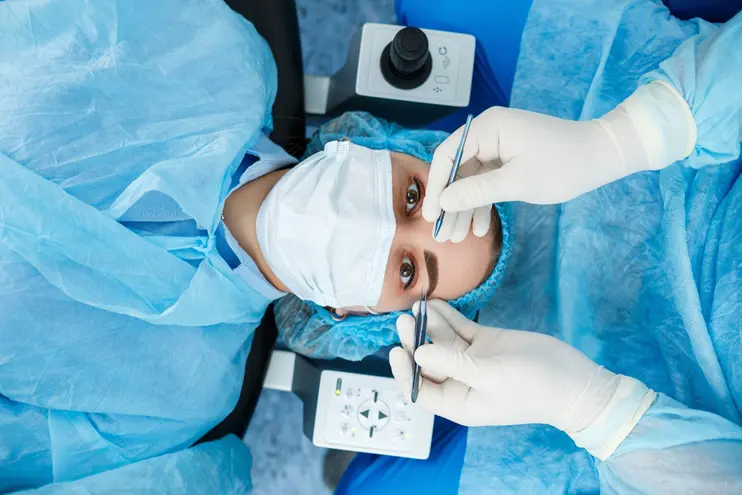
Patients often ask, “Will you operate on both eyes the same way?”
In asymmetry cases, the honest answer is usually no.
One eye may require muscle tightening while the other needs only crease adjustment. One side may benefit from ptosis correction, while the other is left untouched. This imbalance in surgical approach is what ultimately creates visual balance.
Common procedures used in customized asymmetry correction include:
Ptosis Correction with Differential Adjustment
Even a 1–2 mm difference in levator strength can dramatically change eye size. Subtle advancement or reinforcement of the muscle on one side can restore symmetry without creating a “wide-eyed” look.
Customized Double Eyelid Crease Design
Crease height, depth, and fixation points may differ between eyes. Matching the visual effect matters more than matching measurements.
Lateral or Medial Canthal Adjustment
In select cases, the eye opening angle contributes to asymmetry more than the lid itself. These adjustments are conservative and anatomy-driven, especially in patients concerned about overexposure.
Fat Repositioning or Preservation
Removing fat unevenly is one of the most common causes of postoperative asymmetry seen in revision cases. At Sinsang, fat is evaluated as a structural support, not excess tissue to be aggressively removed.
What ties all of this together is restraint. The goal is not to chase perfection, but to restore balance that looks natural at conversational distance — not just in selfies.
What Recovery Is Really Like — Especially When Each Eye Is Treated Differently
One concern patients often voice is uneven swelling after surgery. This is not only common, it’s expected in asymmetry correction.
When each eye undergoes a different level of adjustment, healing timelines vary slightly. One side may look more swollen for a week or two. The other may settle faster. This can be emotionally challenging if patients aren’t prepared.
At our clinic, we emphasize long-view recovery. Eye symmetry continues to refine over several months as internal tissues stabilize and muscle tension equalizes.
Early postoperative asymmetry does not indicate failure. In fact, it often reflects appropriate correction.
This is also where regenerative support plays a role. Our in-house stem cell–based regenerative protocols are used to support tissue healing, reduce prolonged inflammation, and improve scar quality — not to change the surgical result, but to help the body express it more smoothly.
Natural Results Depend on Understanding Korean Aesthetic Sensibility

In Gangnam, patients are particularly sensitive to the fear of looking “overdone.” This concern is valid.
Eyes that are too symmetrical, too open, or too sharply defined can disrupt facial harmony — especially in Asian facial anatomy, where softness and continuity matter.
At Sinsang, we often say that successful eye surgery should be unnoticeable as surgery. Friends might comment that you look more rested, more open, or more balanced — without identifying why.
This philosophy guides every decision, from incision placement to suture tension. Our surgeons frequently choose undercorrection over aggressive alignment, knowing that subtlety ages better and feels more authentic to the patient.
Who Is a Good Candidate for Customized Asymmetry Correction?
Patients who benefit most are those who:
- Notice consistent eye imbalance in daily life, not just photos
- Feel discomfort with makeup symmetry or eye fatigue
- Have mild ptosis on one side
- Are seeking refinement, not transformation
For foreign patients visiting Korea, asymmetry correction is often appealing because it prioritizes individualized design over standardized results. Multilingual consultation and extended follow-up planning are part of how we support these cases safely.
A Final, Honest Thought
If you’re worried about asymmetrical eyes, you’re not being overly sensitive — but you also don’t need drastic change. Most eye asymmetries are solvable with careful diagnosis, conservative correction, and realistic expectations.
The most important decision isn’t the procedure itself, but where and how it’s planned.
If these concerns sound familiar, a consultation with a board-certified surgeon who specializes in customized, anatomy-driven eye surgery — like the team at Sinsang Plastic and Reconstructive Surgery — can help you understand what balance might look like for your face, not someone else’s.
And sometimes, that clarity alone is already the first step toward confidence.
Clinical Guidance & Recovery Considerations
All surgical and non-surgical treatments carry potential risks such as temporary swelling, bruising, asymmetry, or infection depending on individual anatomy. Detailed indications and personalized recovery expectations are confirmed during in-person ultrasonic evaluation with a Sinsang board-certified specialist.
Patient Concierge
Gangnam Station / Sinsa Area · 150 Dosan-daero 5F–6F, Seoul
Mon–Thu 10:00–19:00 · Fri 10:00–21:00 · Sat 10:00–17:00
Online Inquiry Form →WhatsApp (+1 201-940-3238)LINE (@853akazy)CONTINUE EXPLORING
More Medical Insights

Rising Demand for Double Chin Revision Surgery: Korean Market Price Trends
Rising Demand for Double Chin Revision Surgery: Korean Market Price Trends
Explore →

What is fat grafting - Procedure, Uses, Types, Benefits, and Risks
What is fat grafting - Procedure, Uses, Types, Benefits, and Risks
Explore →

Why 9,000 Global Patients Chose Seoul for Specialized Neck Contouring Surgery
Why 9,000 Global Patients Chose Seoul for Specialized Neck Contouring Surgery
Explore →
INTERNATIONAL CONCIERGE · GANGNAM, SEOUL
Begin Your Personalized Surgical Plan With Sinsang Specialists
Share your goals online or connect directly via our official WhatsApp or LINE concierge for pre-travel assessment and scheduling.