
CLINICAL ARTICLE
Can You Completely Erase a Tattoo? What’s Realistic
Can you completely erase a tattoo? Learn what’s realistically possible with today’s removal methods, from lasers to new tech. Get the facts—explore your options!
Can You Completely Erase a Tattoo? What’s Realistic
Most people who ask about tattoo removal are not chasing perfection for cosmetic reasons alone.
They are trying to close a chapter.
Sometimes it’s a name that no longer belongs in their life.
Sometimes it’s a symbol that no longer matches who they’ve become.
Sometimes it’s simply the quiet discomfort of carrying a visible mark that no longer feels like them.
So when a patient asks, “Can you completely erase a tattoo?”, what they usually mean is:
“Can my skin look normal again—without explaining myself?”
The honest answer is layered. Tattoo removal is real medicine, not magic, and understanding its limits is the difference between satisfaction and regret.
At Sinsang Plastic and Reconstructive Surgery, we approach tattoo removal with the same surgeon-responsibility mindset we apply to reconstructive and aesthetic surgery: precise evaluation, realistic planning, and long-term skin health over promises.
Let’s go deeper.
Why Tattoos Are Designed to Be Permanent?
To understand removal, you must first understand permanence.
Tattoo ink is deliberately placed into the dermis, the middle layer of the skin. This layer does not renew itself like the epidermis. It exists to provide strength, elasticity, and stability—exactly why ink placed here lasts for decades.
When ink is injected, the body responds immediately:
- Immune cells attempt to engulf pigment particles
- Fibroblasts and connective tissue surround remaining ink
- The particles are too large to be fully removed
The result is a stable equilibrium: the body tolerates the ink, and the tattoo remains visible.
Tattoo removal does not “erase” ink. It changes the ink into something your body can finally process.
How Laser Tattoo Removal Actually Works (And Why It Takes Time)?
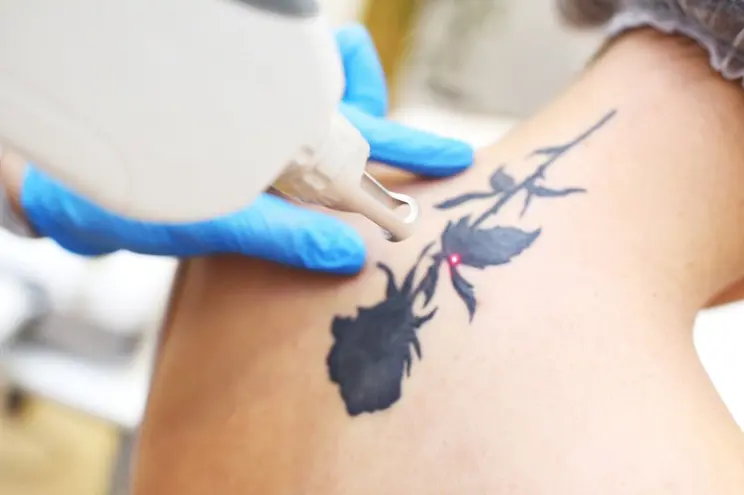
Modern laser tattoo removal uses ultra-short energy pulses to target pigment.
The laser does three things only:
- Delivers energy specific to certain ink colors
- Shatters ink particles into smaller fragments
- Triggers an immune response
That’s it.
Everything else—clearing, fading, smoothing—is done by your body.
This is why two patients treated with the same laser, by the same doctor, can have completely different results. One clears ink efficiently. Another holds onto faint remnants for years.
This is biology, not error.
The Five Determinants of “Complete” Removal
1. Ink Color: Chemistry Matters More Than Technology
Black ink is carbon-based and absorbs laser energy efficiently. This is why black tattoos respond best and often fade dramatically.
Other colors behave differently:
- Dark blue / navy: usually responsive
- Red / orange: variable, depending on pigment formulation
- Green: one of the most resistant
- Yellow: extremely difficult
- White: unpredictable; may darken before fading
Many modern tattoos use layered colors. Even if the black outline disappears completely, residual color may remain.
No ethical clinic can promise total removal without analyzing ink composition first.
2. Ink Depth and Density Are Uneven—even in One Tattoo
Even within a single design, ink is not placed uniformly.
Professional artists vary pressure, angle, and needle depth. Overworked areas may hold more pigment deeper in the dermis, while lighter shading sits more superficially.
This explains why some parts of a tattoo disappear quickly while others linger stubbornly.
Older tattoos often respond better because the body has already cleared some pigment naturally over time.
3. Skin Type, Melanin, and Healing Response
Skin tone does not prevent tattoo removal—but it changes how we approach it.
Melanin competes with ink for laser energy. In darker skin tones:
- Energy settings must be more conservative
- Sessions are spaced further apart
- Risk of post-inflammatory pigmentation increases
Additionally, individual healing tendencies matter:
- Some patients scar easily
- Some develop prolonged redness
- Some clear inflammation rapidly
This is why a standardized “number of sessions” is meaningless without personal assessment.
4. Location on the Body Influences Clearance Speed
Circulation and lymphatic drainage are critical for ink removal.
Areas with strong blood flow clear faster:
- Face
- Upper chest
- Upper arms
Areas with weaker circulation clear slower:
- Ankles
- Feet
- Fingers
- Lower legs
Even with perfect laser technique, tattoos in distal areas may never reach full invisibility.
This is anatomy, not failure.
5. Time Is a Treatment Component, Not an Inconvenience
One of the most common mistakes patients make is rushing.
Laser sessions are spaced weeks apart because the immune system needs time to process fragmented ink. Treating too frequently increases inflammation—but not clearance.
More sessions closer together does not mean faster removal. Often, it means more skin trauma and poorer final texture.
Patients who respect biological pacing consistently achieve better outcomes.
What Does “Completely Gone” Mean—Medically?
This is where expectations must be clarified.
From a clinical standpoint, true complete removal would mean:
- No visible pigment
- No shadowing under different lighting
- No textural change
- No scarring
- No color shift
This is possible—but uncommon.
What is far more realistic and achievable is:
- Tattoo not visible in daily social interaction
- No recognizable shape or lettering
- Skin tone appears even
- No one notices unless actively searching
For most patients, this is functionally “erased.”
The Concept of the “Tattoo Ghost”
Some patients notice a faint outline or shadow even after successful removal.
This is not always residual ink.
It may be:
- Dermal fibrosis from the original tattoo process
- Structural skin changes from repeated inflammation
- Subtle pigment variation unrelated to ink
Chasing this “ghost” aggressively often worsens skin quality.
At Sinsang, we prioritize skin restoration after ink reduction, often using regenerative approaches to improve dermal health rather than continuing unnecessary laser sessions.
Can Surgical Excision Remove a Tattoo Completely?
Yes—by removing the skin itself.
Surgical excision physically eliminates ink but replaces it with a scar. For:
- Very small tattoos
- Low-tension areas
- Patients who prioritize certainty over aesthetics
this can be appropriate.
For larger tattoos, the scar often becomes more noticeable than the tattoo ever was.
Complete removal is not always the best outcome.
Why Guarantees Are a Warning Sign?
Any clinic that guarantees “100% tattoo removal” without thorough evaluation is ignoring biology.
Medicine operates in probabilities, not promises.
Responsible treatment means explaining:
- What can be achieved
- What is unlikely
- What risks exist
- When to stop
At Sinsang Plastic and Reconstructive Surgery, our goal is not to sell sessions—it’s to protect your skin and your trust.
So—Can You Completely Erase a Tattoo?
Sometimes.
Often, nearly.
Always, with thoughtful planning.
The most important decision is not the laser—it’s choosing a clinic that treats tattoo removal as a medical process, not a cosmetic transaction.
If you’re considering tattoo removal, a surgeon-led consultation that evaluates ink, skin, location, and healing potential can save you time, money, and disappointment.
And just as importantly, it can help you move forward without carrying unnecessary marks from the past—on your skin or in your expectations.
At Sinsang Plastic and Reconstructive Surgery, that honesty is where every treatment begins.
Clinical Guidance & Recovery Considerations
All surgical and non-surgical treatments carry potential risks such as temporary swelling, bruising, asymmetry, or infection depending on individual anatomy. Detailed indications and personalized recovery expectations are confirmed during in-person ultrasonic evaluation with a Sinsang board-certified specialist.
Patient Concierge
Gangnam Station / Sinsa Area · 150 Dosan-daero 5F–6F, Seoul
Mon–Thu 10:00–19:00 · Fri 10:00–21:00 · Sat 10:00–17:00
Online Inquiry Form →WhatsApp (+1 201-940-3238)LINE (@853akazy)CONTINUE EXPLORING
More Medical Insights

Rising Demand for Double Chin Revision Surgery: Korean Market Price Trends
Rising Demand for Double Chin Revision Surgery: Korean Market Price Trends
Explore →

What is fat grafting - Procedure, Uses, Types, Benefits, and Risks
What is fat grafting - Procedure, Uses, Types, Benefits, and Risks
Explore →

Why 9,000 Global Patients Chose Seoul for Specialized Neck Contouring Surgery
Why 9,000 Global Patients Chose Seoul for Specialized Neck Contouring Surgery
Explore →
INTERNATIONAL CONCIERGE · GANGNAM, SEOUL
Begin Your Personalized Surgical Plan With Sinsang Specialists
Share your goals online or connect directly via our official WhatsApp or LINE concierge for pre-travel assessment and scheduling.