

CLINICAL ARTICLE
Can Regenerative Medicine Treat Deep Wrinkles?
Explore how regenerative medicine can treat deep wrinkles by stimulating collagen and skin repair. Discover natural, lasting results. Learn more today!
Can Regenerative Medicine Treat Deep Wrinkles?

This is a question we hear often — especially from patients who have tried almost everything.
They’ve invested in lasers, energy devices, high-concentration skincare, and sometimes years of fillers. The surface of the skin may look smoother, but the deep wrinkles remain. Or worse, the face begins to look stiff, heavy, or unnatural.
At that point, many patients ask us quietly:
“Is there anything that actually improves the skin itself — not just covers the problem?”
The short answer is yes, but with important limitations.
Regenerative medicine can play a meaningful role in improving deep wrinkles — when it is used correctly, and when expectations are realistic. It is not a magic eraser. It is a biological strategy that works best when paired with proper structural understanding of facial aging.
At Sinsang Plastic and Reconstructive Surgery, regenerative medicine is not marketed as a standalone miracle. It is integrated into a surgeon-led treatment plan that respects anatomy, aging patterns, and long-term outcomes.
Let’s explain what regenerative medicine can — and cannot — do for deep wrinkles.
Why Deep Wrinkles Are Different?
Not all wrinkles are the same.
Fine lines often form due to dehydration, repetitive muscle movement, or superficial collagen loss. These can respond well to skincare, lasers, or neuromodulators.
Deep wrinkles, however, are structural.
They develop because of a combination of:
- Long-term collagen breakdown
- Loss of facial fat support
- Changes in ligament tension
- Bone resorption with age
- Repeated folding of the skin over weakened support
In other words, deep wrinkles are not just a skin problem. They are the visible result of aging at multiple layers — skin, fat, fascia, and bone.
This is why many treatments that focus only on the surface fail to produce lasting improvement.
What Regenerative Medicine Actually Means in Aesthetics?
Regenerative medicine is often used as a marketing term, so it’s important to clarify what it truly involves in a medical setting.
In aesthetic and reconstructive surgery, regenerative approaches commonly include:
- Adipose-derived stem cells from fat tissue
- Platelet-rich plasma (PRP)-Biologically active growth factors-Autologous tissue restoration rather than synthetic materials
These therapies aim to improve tissue quality, not just appearance.
Regenerative treatments work by supporting:
- Collagen remodeling
- Improved blood supply
- Cellular repair mechanisms
- Skin elasticity and resilience
What they do not do is instantly erase deeply etched folds caused by structural collapse.
Understanding this distinction is essential.
How Regenerative Medicine Helps With Deep Wrinkles?

So, can regenerative medicine treat deep wrinkles?
The honest answer is: it can improve them — but rarely on its own.
Here’s how regenerative approaches contribute meaningfully:
1. Improving Skin Quality Over Wrinkles
Regenerative therapies can thicken the dermis, improve elasticity, and enhance hydration. This softens the appearance of deep wrinkles, making them less sharp and less shadowed.
Patients often describe this as their skin looking “healthier” or “more alive,” even if the wrinkle itself doesn’t disappear completely.
This improvement matters more than many people realize.
Wrinkles on poor-quality skin look deeper and harsher than the same wrinkles on resilient, well-nourished skin.
2. Supporting Long-Term Healing After Structural Correction
One of the most underappreciated roles of regenerative medicine is what it does after surgery or volume restoration.
For example:
- After a facelift, regenerative therapy can improve skin recovery and texture
- After fat grafting, stem cell-rich tissue supports graft survival
- After wrinkle release, regenerative signals improve tissue integration
At Sinsang, regenerative medicine is often used to enhance surgical outcomes, not replace surgery.
This is where it truly excels.
3. Softening Wrinkles Caused by Volume Loss
Some deep wrinkles — particularly nasolabial folds or marionette lines — deepen because of underlying volume loss, not skin damage alone.
In these cases, regenerative fat grafting can play a dual role:
- Restoring structural support
- Delivering stem cells that improve skin quality
This combination is far more effective than fillers or surface treatments alone.
Where Regenerative Medicine Has Clear Limits?
It’s important to be direct about what regenerative medicine cannot do.
Regenerative treatments alone cannot:
- Lift significantly sagging skin
- Correct advanced jowling
- Eliminate deeply fixed folds caused by ligament laxity
- Replace the structural effect of a facelift
If deep wrinkles are primarily caused by tissue descent, no amount of stem cells or PRP will reposition anatomy.
This is not a failure of regenerative medicine — it’s a matter of respecting anatomy.
The Most Common Misconception We See
One of the most common misunderstandings is the belief that stem cells can “reverse aging.”
Aging is not a single process. It is a gradual, layered change.
Regenerative medicine does not turn aged tissue into youthful tissue. Instead, it improves how existing tissue functions and heals.
When patients expect dramatic wrinkle removal without addressing volume loss or sagging, disappointment is almost guaranteed.
This is why consultation quality matters more than the treatment itself.
A Surgeon’s Perspective: Treat the Cause, Not the Wrinkle
At Sinsang Plastic and Reconstructive Surgery, we rarely ask,
“How do we treat this wrinkle?”
Instead, we ask:
- Why did this wrinkle form here?
- Is it caused by volume loss, descent, muscle activity, or skin damage?
- Which layer is failing first?
Only then do we decide whether regenerative medicine is appropriate — and how it should be combined with other treatments.
In many cases, the most effective approach for deep wrinkles is layered:
- Structural correction where needed (such as a facelift or fat grafting)
- Regenerative therapy to improve tissue quality and healing
- Conservative surface treatments for refinement
This strategy respects both anatomy and biology.
Why Fat-Based Regenerative Therapy Is Different?
Among regenerative options, fat-derived regenerative therapy deserves special mention.
Fat is not inert filler. It is living tissue rich in stem cells, growth factors, and vascular support.
When processed carefully and injected properly, it can:
- Restore volume naturally
- Improve skin thickness and texture
- Support long-term tissue health
At Sinsang, our in-house stem cell laboratory allows us to handle fat with precision, preserving its regenerative capacity. This level of control is critical — poorly processed fat loses much of its biological benefit.
This is also why technique matters as much as technology.
Who Benefits Most From Regenerative Approaches for Wrinkles?
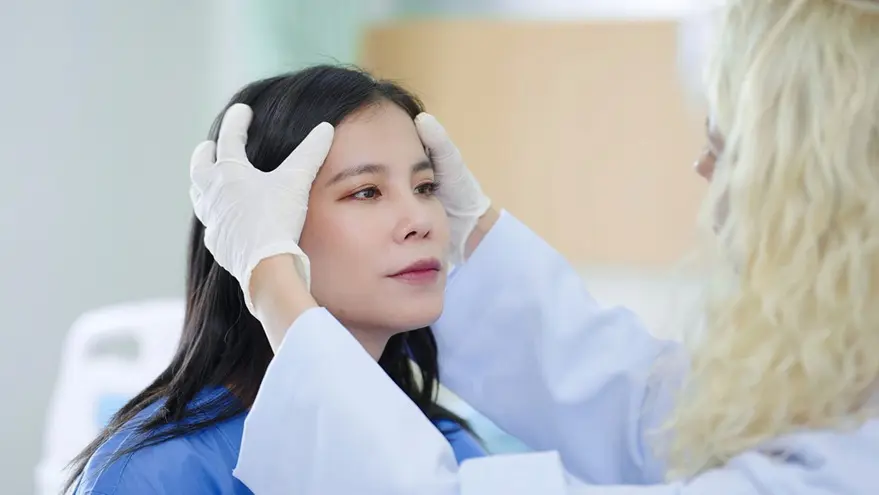
Regenerative medicine tends to work best for patients who:
- Have early to moderate deep wrinkles
- Notice thinning, fragile, or dull skin
- Want natural improvement rather than dramatic change
- Are undergoing or considering structural procedures
- Value long-term skin health over quick fixes
It is less effective as a standalone solution for advanced aging with significant sagging.
Honest evaluation is essential.
Choosing a Clinic Matters More Than Choosing a Treatment
Regenerative medicine is powerful — but only when used responsibly.
In Gangnam, many clinics advertise stem cell or regenerative treatments without proper surgical oversight. This often leads to overpromising and underdelivering.
At Sinsang Plastic and Reconstructive Surgery:
- All regenerative treatments are surgeon-planned and surgeon-performed
- Led by Dr. Young Jae Lee, former clinical professor and facelift specialist
- Supported by a team of six board-certified plastic surgeons
- Integrated with advanced diagnostics such as 3D analysis and ultrasonic imaging
- Focused on long-term outcomes, not temporary trends
Regeneration is not about chasing youth. It is about supporting the face as it ages.
A Final, Honest Answer
So — can regenerative medicine treat deep wrinkles?
Yes, it can improve them.
No, it cannot do everything on its own.
When used thoughtfully, regenerative medicine softens deep wrinkles, improves skin quality, and enhances surgical results. When used carelessly or in isolation, it often disappoints.
If you are concerned about deep wrinkles and want a solution that respects both science and aesthetics, the first step is not choosing a treatment — it’s choosing a surgeon who understands why those wrinkles exist in the first place.
At Sinsang Plastic and Reconstructive Surgery, we believe the best results come from treating the face as a living structure — not a surface problem.
And that perspective makes all the difference.
Clinical Guidance & Recovery Considerations
All surgical and non-surgical treatments carry potential risks such as temporary swelling, bruising, asymmetry, or infection depending on individual anatomy. Detailed indications and personalized recovery expectations are confirmed during in-person ultrasonic evaluation with a Sinsang board-certified specialist.
Patient Concierge
Gangnam Station / Sinsa Area · 150 Dosan-daero 5F–6F, Seoul
Mon–Thu 10:00–19:00 · Fri 10:00–21:00 · Sat 10:00–17:00
Online Inquiry Form →WhatsApp (+1 201-940-3238)LINE (@853akazy)CONTINUE EXPLORING
More Medical Insights

Rising Demand for Double Chin Revision Surgery: Korean Market Price Trends
Rising Demand for Double Chin Revision Surgery: Korean Market Price Trends
Explore →

What is fat grafting - Procedure, Uses, Types, Benefits, and Risks
What is fat grafting - Procedure, Uses, Types, Benefits, and Risks
Explore →

Why 9,000 Global Patients Chose Seoul for Specialized Neck Contouring Surgery
Why 9,000 Global Patients Chose Seoul for Specialized Neck Contouring Surgery
Explore →
INTERNATIONAL CONCIERGE · GANGNAM, SEOUL
Begin Your Personalized Surgical Plan With Sinsang Specialists
Share your goals online or connect directly via our official WhatsApp or LINE concierge for pre-travel assessment and scheduling.